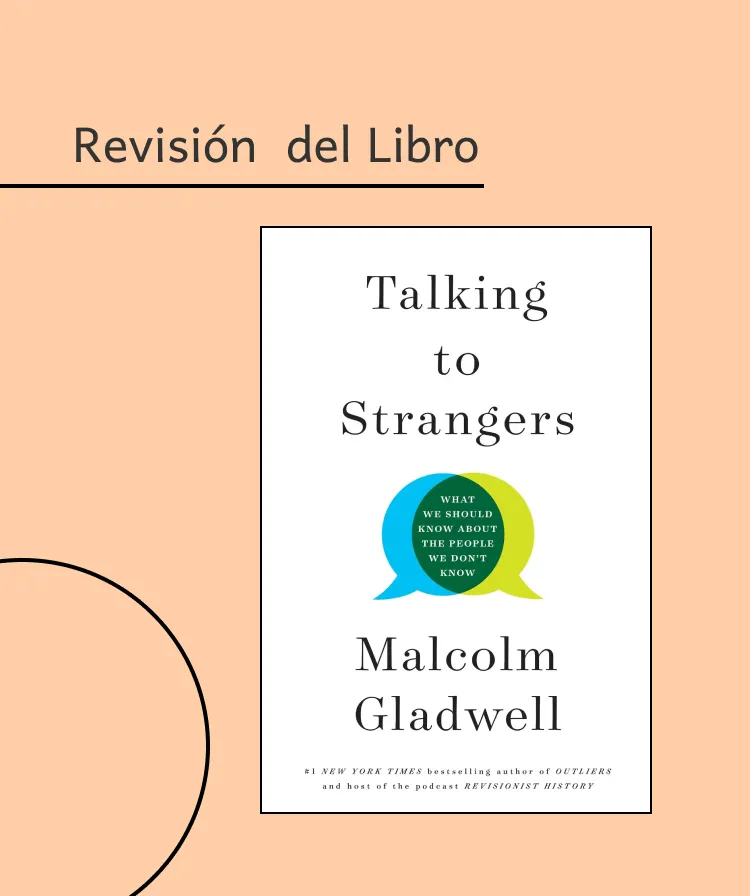
What We Should Know about the People We Don’t Know. Malcolm Gladwell, 2019.
Original title: Talking to Strangers: What We Should Know about the People We Don’t Know.
I first hesitated about whether to finish reading the book, feeling a lot of anxiety, and then doubted whether to write about it. Why? Because the content of this book didn’t leave me indifferent; it showed me a side of people I prefer not to see (and the book says that most people prefer this too).
The author, Gladwell, shows through the narration of various political and judicial cases the complex side of not understanding the other in a first encounter (or even several first encounters).
What the book is about
The author is a journalist and essayist who has written several bestsellers on topics of psychology, sociology, and history. In this book, Gladwell uses real cases and scientific studies to show how our assumptions, prejudices, and expectations can lead us to misinterpret the intentions, emotions, and character of strangers.
The book is divided into three central ideas:
1. Transparency bias:
The belief that we can read other people’s moods and thoughts through their body language and facial expressions. Gladwell demonstrates that this belief is false and that we often make mistakes when judging strangers by their appearance. For example, he analyzes the case of Amanda Knox, an American student accused of murder in Italy, whose cold and distant attitude was interpreted as proof of her guilt.
2. Coupling versus displacement:
The tendency to associate people’s behavior with their personality and circumstances. Gladwell argues that this tendency prevents us from seeing the influence of context and environment on others’ actions. For example, he examines the case of Sylvia Plath, a poet who committed suicide, where according to the author, circumstances favored that decision, unlike the idea of “displacement” where the means (context or circumstances) don’t matter to accomplish something.
3. The default to truth:
The propensity to trust strangers and give them the benefit of the doubt. Gladwell affirms that this propensity makes us vulnerable to deception and manipulation. The author invites us to be more skeptical and critical when talking to strangers, but also recognizes that this can have an emotional and social cost.
Conclusion
The book concludes with a reflection on the need to “be more humble and cautious when talking to strangers”. Gladwell recognizes that there is no easy solution to this problem, but suggests that we can improve our communication if we are more curious, empathetic, and tolerant with others (and we can do this in our daily lives, not only in extreme cases like in the book, but at home with our partner, children, friends, parents, colleagues… and of course with clients and users).
Talking to Strangers is a book that invites us to question our certainties and broaden our perspective. Along the way, it teaches us a lot about ourselves and the world around us.
Here’s a video of the author with a summary of the book.
Video of the author talking about the book “Talking to strangers”.
Further reading:
- https://www.theguardian.com/books/2019/oct/20/talking-to-strangers-malcolm-gladwell-review
- https://www.nytimes.com/2019/08/30/business/malcolm-gladwell-talking-to-strangers.html
Additional comments
Our current world is increasing in complexity, where more than ever we can interact with strangers from different parts of the world, but what doesn’t change at the same pace are our mental patterns, our biases - these remain the same as thousands of years ago. Just because we don’t want to see that darker side doesn’t mean it doesn’t exist.
The ending provides some relief from the heaviness of the rest of the book. The author recommends that we should be “humble and cautious” when drawing conclusions about what we see and hear in a single moment of a person’s life and consider the context when making judgments.
I don’t regret reading it, but I would recommend it with the caveat that you will encounter a less luminous side of human nature.
Thanks for reading 🙂