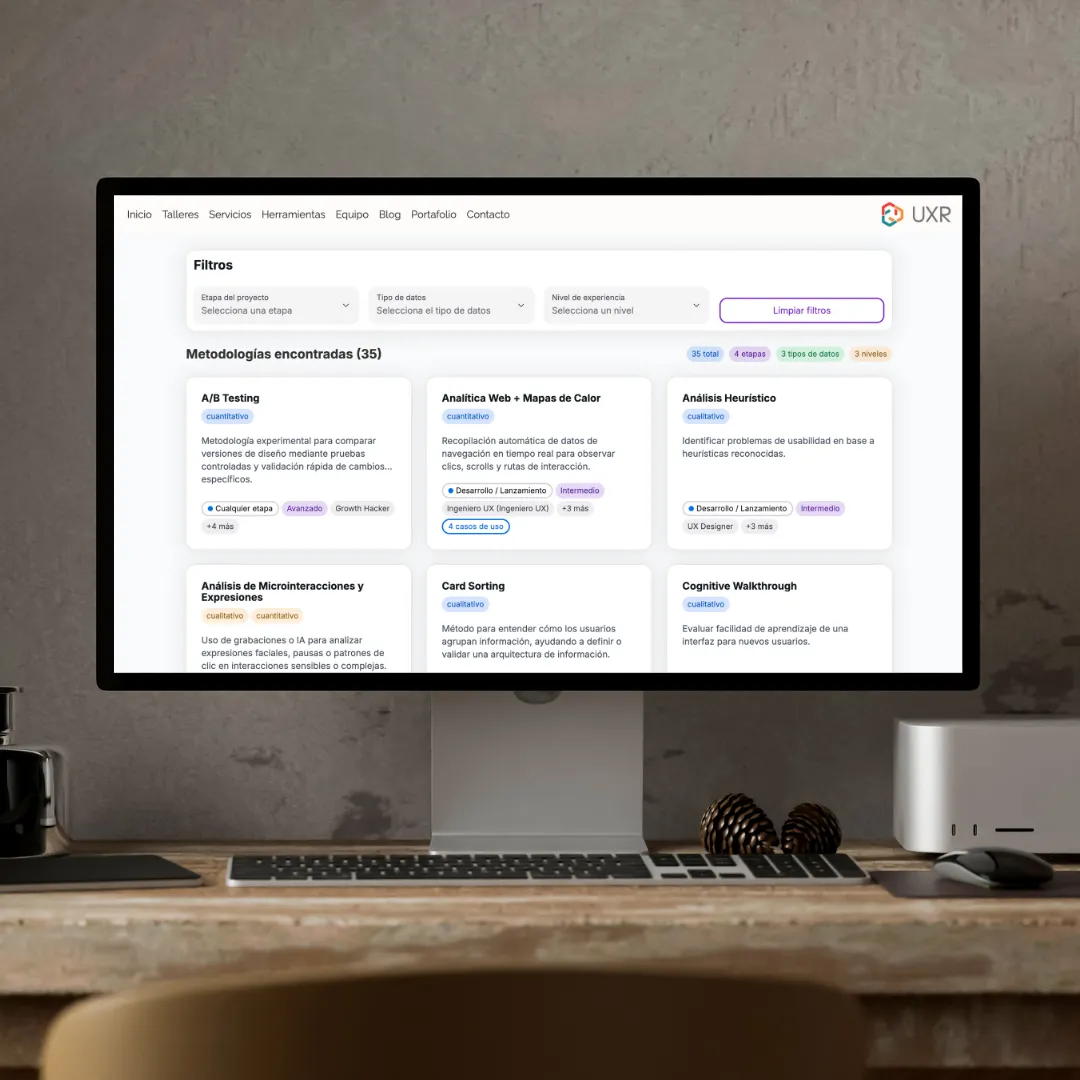
How and Why I Built the UX Methodology Selector (v1)
Since I’ve been working in UX—and later as a UX Researcher—choosing the right methodology for each project has been a recurring challenge. I first experienced it firsthand when I was junior: justifying why to use a tool and answering the classic question “which one is the best?”
Spoiler: there is no “best” one. What exists are methodologies that are more or less suitable according to the unique characteristics of each research project.
Over time, I discovered that this confusion wasn’t just mine, especially in early stages of the UX journey or when there isn’t systematic dedication to research. That’s why, for years, I wanted to design a resource to guide that decision. At first, I imagined it as a visual flow in Figma/Miro. Today, with AI as an ally, I took the step and created the first version of a UX Methodology Selector, powered by Claude AI.
What does the first version contain?
It includes 35 methodologies, selected based on three initial questions that function as basic filters to guide the choice:
- Project stage (Design Thinking).
- Data type (qualitative, quantitative, mixed).
- Experience level (basic, intermediate, advanced).
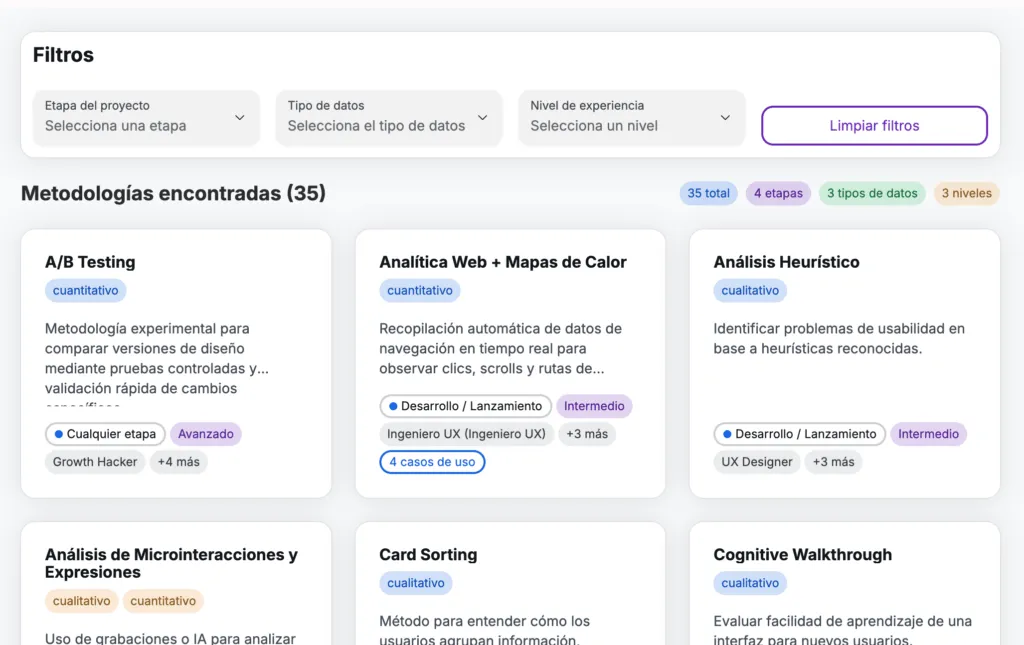
They are not definitive, but they open the path. And, although useful, these three are not always the most relevant: the real choice emerges from mixed information—the “classic” (objective, stage, type of result) and the “contextual” (constraints, user access, time, etc.)—which, together, lead us to a reduced set of options.
What comes next?
I want to expand the selector with more complete blocks that integrate questions like:
- Project context: product stage, current user knowledge, type of decisions to inform.
- Constraints: available time, resources, recruitment budget.
- Users and access: actual access to users, number of possible participants.
- Type of research question: behaviors, perceptions, usability; explore or validate.
- Expected results: quick insights, actionable recommendations, formal reports for stakeholders.
From these answers, the tool will be able to suggest a more refined and realistic set of methodologies.
Limitations and opportunities
The selector does not replace professional judgment or experience. It depends on assumptions like budget, time, expertise, or team availability. Even so, it does provide a clear initial guide to move forward with focus.
Finally
This is just the first version and I want to improve it with feedback. If you use it, tell me about your experience at paulina@uxr.cl or on the LinkedIn post. I invite you to try the Methodology Selector here: uxr.cl/en/tools/methodology-selector/
Here’s a demo video of the selector 😀