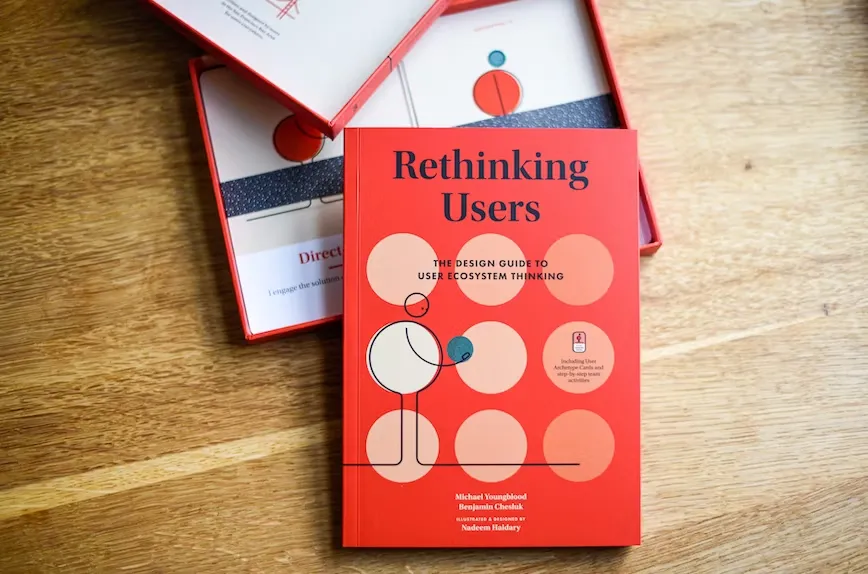
The Design Guide to User Ecosystem Thinking. Youngblood & Chesluk, 2020
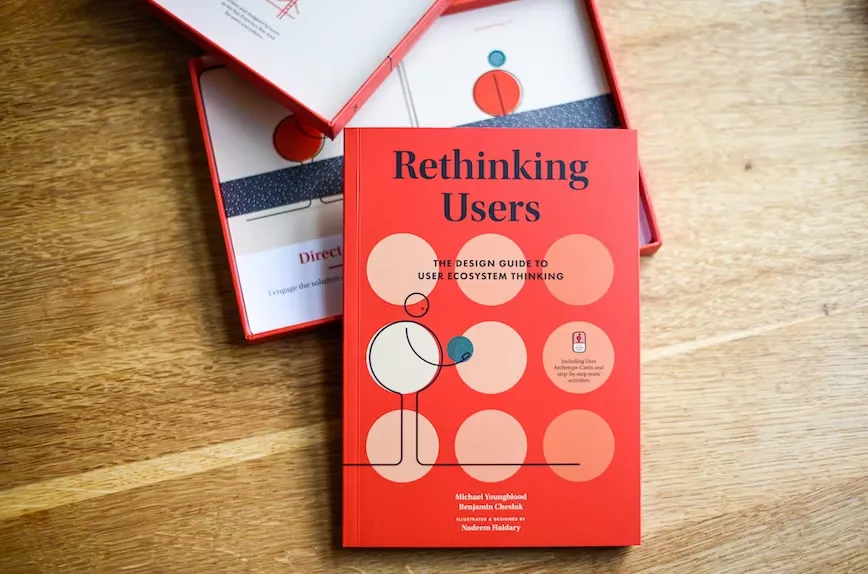
Book cover: Rethinking users (rethinkingusers.com/)
I bought this book in 2021 when I was working on building the company’s User Personas, which I described in the article “How to Build User Personas”. I discovered Michael Youngblood’s work through a course I took on User Observation at EPIC People (I recommend checking out the resources on their page), and I really enjoyed his teaching approach.
What is the book about?
Rethinking Users, By Youngblood & Chesluk, 2020. It’s a practical book that introduces a different way of thinking about user experience, challenging the initial question of “who is my user?”. It’s a tool to go beyond the individual user and start looking at the ecosystem of people we live in. It suggests that when we introduce a product/service to the world, it influences not only the initial user it was designed for but the entire environment and people around them.
The book presents 15 archetypes, based on the relationship between a person and an object, or with another person.
The book includes a set of cards and activities to use in teams, containing:
- 1 Book
- 24 Cards (15 User Archetypes + 3 to create your own + 6 Team Exercises)
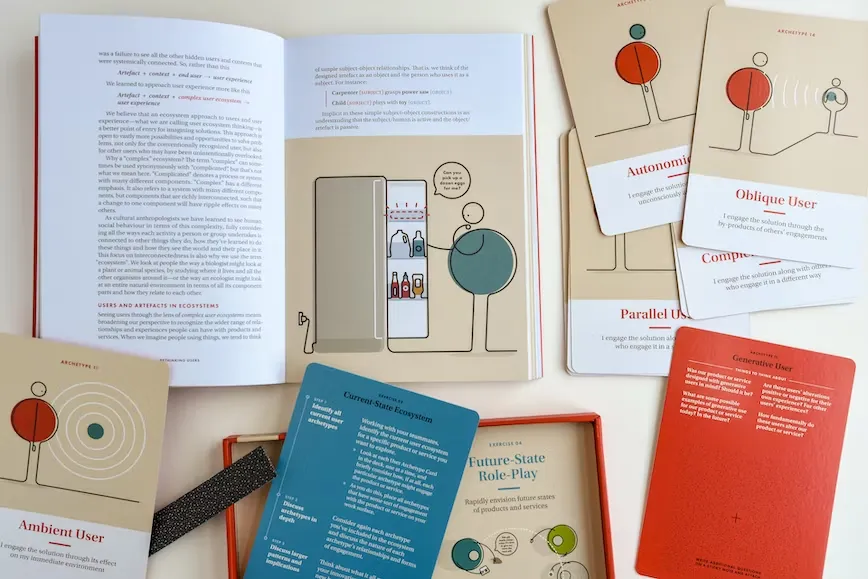
Book: Rethinking users, archetype cards and exercise cards.
It has a book website where, in addition to learning more about what it’s about, the authors make recommendations for use in remote team contexts and for educators in user research.
What did I think?
This book proposes understanding user experience systemically, in that sense it opens the mind to new ways and opportunities to create products and services that encompass the multiplicity of ways in which what we’re designing can be used.
I bought this book as if it were a kind of guide to design User Personas and I found a practical guide to use a systemic view of the user and product and service design. This book urges us to design with intention considering the human ecosystem and how our product can affect other subsystems sometimes in unforeseen ways, even when the designed object is in disuse, like those who recycle or reuse parts of a defective product.
The book manages to make us rethink the user, looking at an entire ecosystem of other potential users of the same product/service.
I was surprised to see the number of archetypes or usage patterns a product/service can have, which on one hand is overwhelming, but at the same time motivates me to start thinking about the products I’m involved with and how these different archetypes are present. The authors don’t prescribe that these 15 archetypes be used all at once, nor always for each product, nor that they’re the only usage patterns, as they even add cards to create your own archetypes, but rather as potential archetypes to consider.
In the User Personas we usually use, there’s greater depth (zoom in) in their psychology: who they are, what motivates them, their pains and expectations. While in this Youngblood and Chesluk model, depth is lost but breadth is gained (zoom out) by looking at an entire ecosystem of users and products that could interact with the initial product/service.
Personally, I missed the theoretical part, I would have liked a 200-page book that talked about the background of systems theory along with the cards, but this is not the book’s proposal, rather a practical one, to get us moving and working as a team from different archetypes. Since I’m stubborn, I looked for an old book that blew my mind at the time related to the topic General System Theory by Bertalanffy, 1968), so now I have the 200-page book and the cards xD.
I’m leaving the recording of the book launch, where you can see the authors presenting it and answering questions.
Book launch: Rethinking Users, 2020.
If you’ve already read the book and have put it into practice in some way, I’d love to hear from you, contact me on Linkedin.
Thank you for reading 🙂