
In a previous article, I shared the details of the process I followed to build User Personas, which involves a long work process to gather, process, and synthesize information about our users. Once that construction phase is completed, we face a new challenge: getting this knowledge about who our customers are to permeate across everyone on the product team (PO, BA, UX, Management).
Many roles in the area knew about the importance of this knowledge, and there was willingness, but daily work can trap us into failing to incorporate that knowledge into everyday tasks: a new requirement, a new product idea, a redesign, incorporating new elements, etc. Facing this challenge, we iterated on several initiatives to generate knowledge and use of User Personas.
Here I share the process and results of those initiatives we implemented as a team to incorporate User Personas into our workflow. This was an exercise developed over several months, testing what worked and what didn’t.
The Before, During, and After of the Presentation
Table of Contents
Here we adopted a vision by stages and subsystems. First, we proposed that it was relevant to make people aware of the existence of these User Personas, and then move to their adoption and use. By systems, I refer to the idea that from my position I work in a large system called organization that is integrated by multiple subsystems of teams, groups of people, formal and informal. So I imagined starting from our small team (2 UX Researchers) provoking the change, then opening the space to the group closest to this subsystem: UXers and Product Designers, and then expanding again to include business… (and finally the whole world xD)
Before
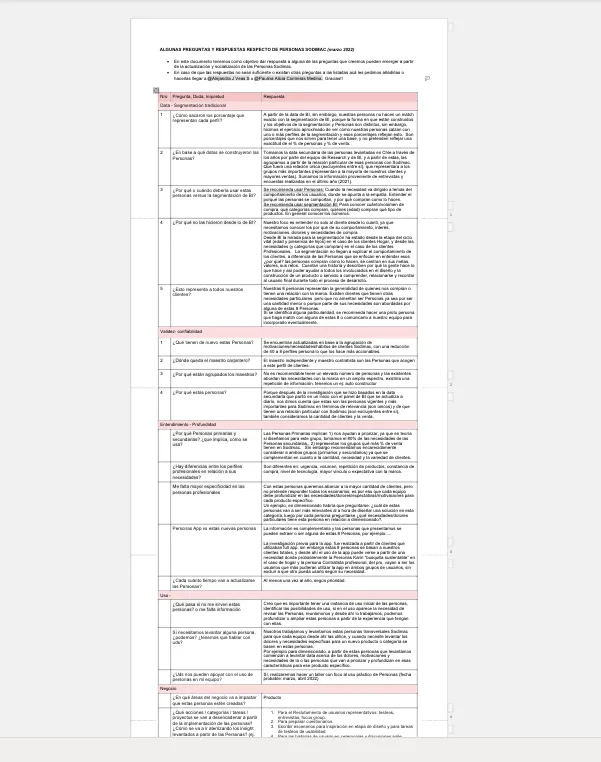
In the previous post about personas, I mentioned that before sharing the User Personas with the entire product area, my colleague and I prepared a document with a series of questions and doubts that we imagined might arise around these User Personas (it was about 4 pages, I think we went overboard :P). Some of the questions we included were:
- What data were the Personas built on?
- Why or when should I use these personas versus BI segmentation?
- Does this represent all our customers?
- Why primary and secondary Personas? What does that mean, how is it used?
- Why these personas?
This document was made available for everyone to access and review, as well as to add new questions.
(Image of the document, in low quality because it’s the original document)
During
– User Personas Presentation
An initial “Kick-off” session was held with the entire area (all UX, POs, and Management!), presenting the work and the User Personas. The presentation lasted 1 hour between presentation and final questions.
We organized the presentation this way:
- What are Personas? Why create them?
- Methodology or process: How we arrived at them
- Difference from internal BI segmentation
- Personas: Primary and Secondary. Detail of each one. What differentiates them from each other
- Next steps
After
– Persona-lity Quiz
After the presentation, we were left with this feeling of “what now?” We had already invested a lot of time in the construction and fully trusted in their value. How can we boost their use by product cells?
The first idea, as a way to generate this Awareness, was through a “Persona(lity) Quiz” that was both fun and serious. This way we promote knowledge, so people remember and identify them.
There were questions that helped segment according to personas, and others just for fun, for example:
- Do you buy for your home or your business?
- Do you prefer tea or coffee? (this question was controversial xD)
– Workshops
In parallel, we began planning training sessions with two focuses: the UX team and the complete cell:
Workshop for UX Team
These were focused on using User Personas in daily work:
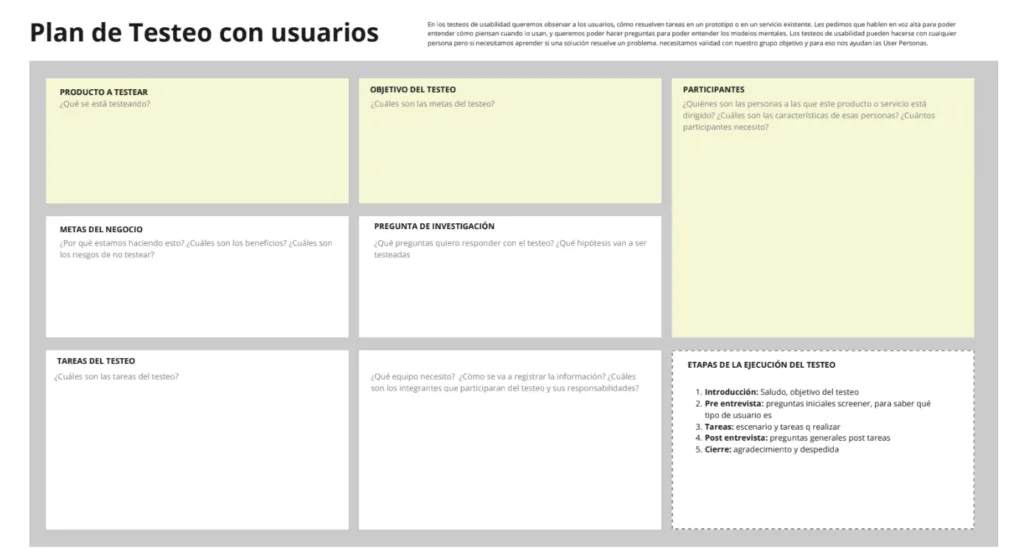
- User Personas in testing (we used the Canvas below to guide the workshop, the focus in this case was working on the yellow quadrants)
- User Personas in new initiatives arising from the cell itself.
User Stories Workshop
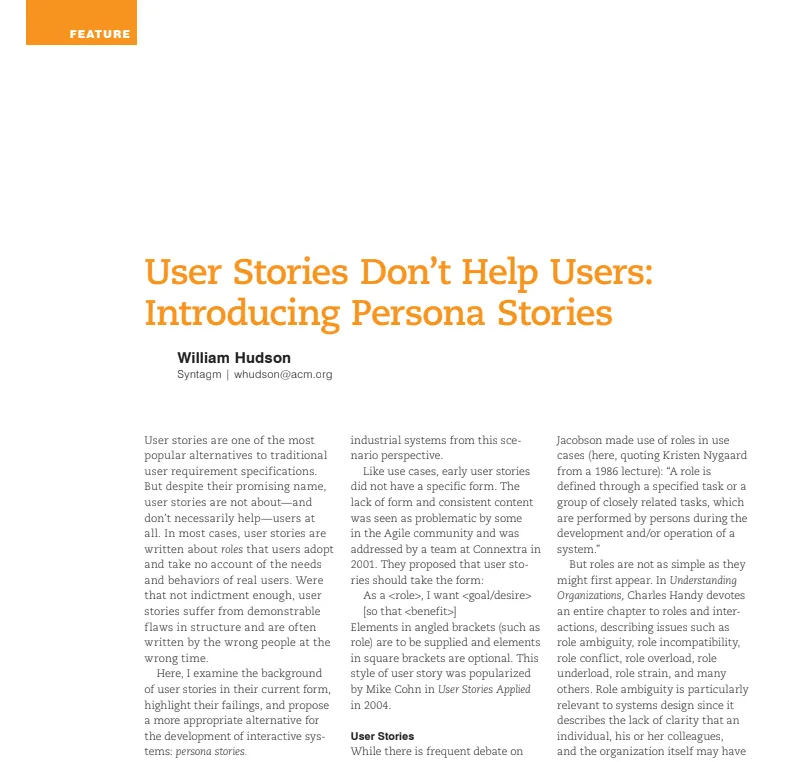
Inspired by Hudson’s article “User Stories don’t help users: introducing persona stories” (image below), we decided to try to incorporate personas into the area’s user stories. A great task that was reflected some time later by creating a template in Jira where the selection of the User Persona that this user story would have as its main objective would live by default.
When creating a new user story, you would have to define which User persona (one or several) it would be focused on.
With this, it no longer depended on teams remembering to include them, or seeing the value, which could lead to one team implementing it as part of their workflow or not, but with this it was already established as part of the process.
Here the User Personas were translated into English for presentation and making them available to development teams, who were not all located in Spanish-speaking countries.
Repository
Finally, and as part of all the previous tasks, the User Personas were made available in a permanently available repository, which did not depend on contacting me or someone else on the team to access them. In our case, it was a repository in Jira, although it also had backup in Miro and Google Drive.
Tracking the Initiatives
As part of these projects to promote the use of Personas, we thought of different ways we could evaluate the effectiveness of these promotion strategies:
- A follow-up questionnaire, aimed at all members of the product area, focused on adoption and use of this tool.
Another point we didn’t initially consider, but when it started happening we began to count it as part of measuring the incorporation of User Personas:
- Team presentations of new initiatives where the User Persona(s) that initiative was focused on was included.
What Happened Next
We managed to work on persona adoption for about 10 months, but due to deep structural changes in the business model (a way of saying merger xD), this work was stopped.
The good thing is that the learning remains and is shared 🙂
Thanks for reading. I’d love to hear/read about your own initiatives in this regard. What did you do? How did it work?
Other Blog Articles
- Reflections from the 7th Experiences Summit 2025: measuring and designing experiences
- How and Why I Built the UX Methodology Selector (v1)
- Clarifying the UX Ecosystem: roles, definitions and stories
- Learn UX Research for Free in 2025
- The Heart of Your UX Research: Practical Guide to Formulating Powerful Questions