
Pride, Prejudice, and Stakeholders: How to Interview Them Without Losing Your Composure
“It is a truth universally acknowledged, that a UX researcher in possession of a new project, must be in want of stakeholder interviews.”
Table of Contents
- Introduction
- Why Interviewing Stakeholders is Vital
- The Mistake I Made (and You Probably Did Too)
- Not All Darcys Are Created Equal
- How to Conduct Stakeholder Interviews (A Manual of Etiquette)
- Conclusion
- References
Introduction

If Jane Austen had worked in UX instead of writing novels in the English countryside, she surely would have noticed that stakeholders are the true protagonists of our drama. Some are intimidating and silent like Mr. Darcy, others talk endlessly without saying anything useful like Mr. Collins, and others demand immediate results with the authority of Lady Catherine de Bourgh.
But, just as Elizabeth Bennet had to overcome her prejudices to understand Darcy’s true nature, we must stop assuming and start asking. If you’re just starting out in research, this article complements the resources for the first stage of UX research that I shared before.
Why Interviewing Stakeholders is Vital
In the UX world, jumping into design without talking to the business is the equivalent of eloping with Mr. Wickham: it seems like a good idea at first, but it will end in disaster and ruin the family’s reputation.
Early in my career, I blindly trusted that methodological rigor would speak for itself. That if I did my job well, the results would be so evident that everyone would understand. Spoiler: it’s not enough :)
Stakeholder interviews are crucial because:
- They break down “Prejudice”: We often assume what the business wants. Interviews give you real information about their context and business objectives, separating gossip from truth.
- They reveal character: Are they seeking innovation or safety? Do they care more about retention or conversion? Understanding your stakeholders’ motivations is vital for project success (and for knowing how to communicate with them later). Communication with stakeholders is a key UX Researcher skill that we sometimes underestimate.
- They secure allies at court: If you involve them from the beginning and make them feel heard, they’ll be your defenders when difficult moments arrive. And believe me, they always arrive.
The Mistake I Made (and You Probably Did Too)
I have to confess something: for a long time, I thought my job ended when I delivered the research report. That if the findings were well documented, with clear methodology and verbatim user quotes, the rest would follow naturally… (SPOILER: it didn’t).
It happened to me on a project where we presented research results and… nothing. Nothing was implemented. We tried another way, explaining differently, showing more data. Nothing either. Until we tried something different: a low-fidelity prototype, a simple wireframe. And there it was. Suddenly everyone understood. They could literally see what we were referring to.
The insight that stayed with me: It’s not about winning an argument or showing every aspect of what you learned. If your stakeholders walk away with 3 clear points, it’s infinitely better than 10 poorly communicated ones.
This learning made me realize something that the researcher ego sometimes doesn’t want to accept: that the stakeholder understands the results is more relevant than demonstrating everything you know. (I talked more about this in Ideas I Had About UX Research… That I No Longer Have, where I share other myths of my own that I’ve debunked).
And here’s where a dangerous cycle I’ve seen (and lived) comes in: you get frustrated because they don’t implement your recommendations → you insist with more data, more arguments → they perceive you as “the person who always comes with the same thing” → they resist you more → you get more frustrated. An infinite loop of frustration.
The way out? Change your approach. It’s not about you or about “the research.” It’s about finding the way that specific person can understand and act.
Not All Darcys Are Created Equal
Here’s another learning that took me time to internalize: stakeholders are not all the same (obvious, right? but in practice we forget).
Not everyone understands the same way:
- Some need words (narrative reports, verbal explanations)
- Others need numbers (metrics, comparisons, percentages)
- Others need images (prototypes, diagrams, wireframes)
- And some need to experience (workshops, participatory exercises)
How do you know what each one needs? Well, that’s what mapping the terrain before diving in is for.
Force Field Analysis (Simplified)
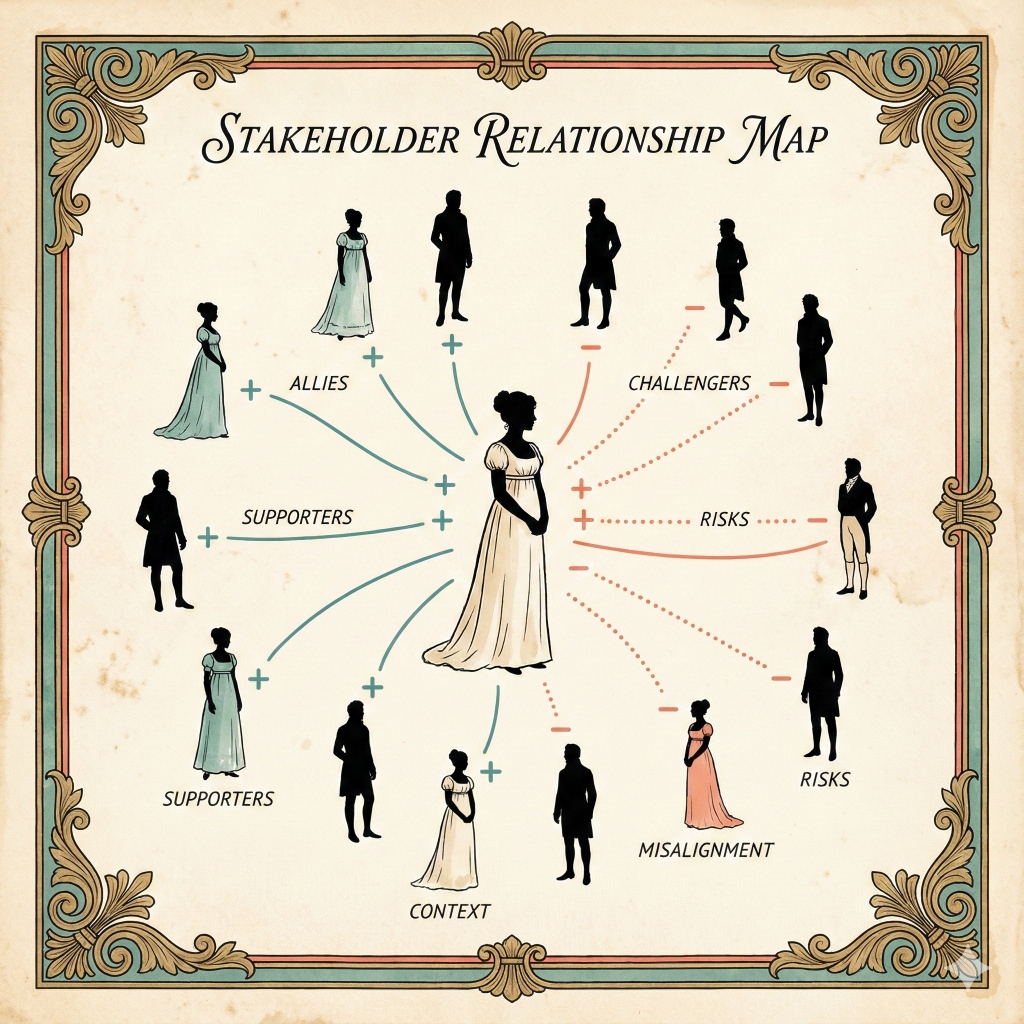
Before running off to schedule interviews, it’s worth making a quick map of your stakeholders (whenever I forget, I regret it later):
- Put yourself at the center (literally, draw yourself)
- Identify the key stakeholders around you (with names, not titles)
- Mark the relationship: do you have a direct relationship or not? (solid line vs. dotted)
- Identify their stance: are they in favor, neutral, or against the research/project?
- Map the relationships between them: who knows whom? who influences whom?
This map helps you see things like: “Ah, I don’t have a direct relationship with the manager who makes decisions, but I do with someone who has their trust.” That completely changes your strategy.
Pro tip: When you feel stuck with a stakeholder, talk to someone who knows them better. Sometimes a colleague with more experience or someone from another team can give you the context you’re missing to understand how to communicate with that person.
How to Conduct Stakeholder Interviews (A Manual of Etiquette)
Interviewing a Marketing Director or a CEO requires as much preparation as a formal dinner at Pemberley. You can’t show up improvising.
1. Preparation is the Key to Virtue
Just like in user interviews, you must prepare:
- Establish an objective: What do you need to know from this specific person?
- Prepare your “dance card” (Interview guide): Use a structured or semi-structured guide. If you need help formulating powerful research questions, I have another article that can help. Don’t trust your memory, not even if you’re as clever as Elizabeth.
- Research beforehand: Review what you know about this person, what role they have in the project, what matters to them.
2. Build Rapport
Don’t jump straight to the questions. Start by sharing the meeting’s objective and setting expectations. Make them feel that their opinion is valuable (because it is).
Something as simple as: “I want to better understand your perspective on X to make sure the research really contributes to the project” completely changes the tone of the conversation.
3. Individual Interviews (Tête-à-tête)
Conduct 1-on-1 interviews. Always.
Why? Because if you put Mr. Darcy (the serious boss) together with Mr. Collins (the employee who wants to impress), Collins will never stop talking or Darcy will never tell the truth due to internal politics.
You need confidentiality to get honest information. Power dynamics greatly affect what people are willing to say.
4. Active Listening (Beyond Words)
Ask the necessary questions to understand the project and context, but above all: listen. Sometimes what’s not said is more important than what is said.
Pay attention to:
- What topics they avoid
- Where they show enthusiasm vs. where they get defensive
- What words they use (do they talk about “users” or “customers”? about “problems” or “opportunities”?)
And if after the interviews you need to choose which research methodology to use, try the UX Methodology Selector I built for that :)
Conclusion
Don’t let Pride (believing you already know everything, or that methodology will speak for itself) nor Prejudice (assuming that stakeholders “don’t understand UX”) ruin your research.
Take the time to converse, listen, and understand. Map the terrain before diving in. Experiment with different ways of communicating (yes, experiment! apply that research mindset inward too). And when you get frustrated—because it will happen—find someone who can help you see the problem from another angle. Elizabeth had Jane, who always reminded her to see the good in others (even in Darcy), and Charlotte Lucas, who gave her the pragmatic perspective even when she didn’t want to hear it. You also need your Janes and your Charlottes: someone who helps you lower your guard, and someone who tells you “ok, but what does this person really need to understand you?”
References
- Austen, J. (1813). Pride and Prejudice. T. Egerton.
- Portigal, S. (2013). Interviewing Users: How to Uncover Compelling Insights. Rosenfeld Media.
- Greever, T. (2015). Articulating Design Decisions: Communicate with Stakeholders, Keep Your Sanity, and Deliver the Best User Experience. O’Reilly Media.
- Online Dialogue. (2024). Leading Organizational Change for Experimentation [Online Course]. CXL Institute.